Campsites along the historic Allagash Wilderness Waterway underwent improvements in 2025 thanks to an ongoing partnership between the state of Maine and the Northern Forest Canoe Trail (NFCT).
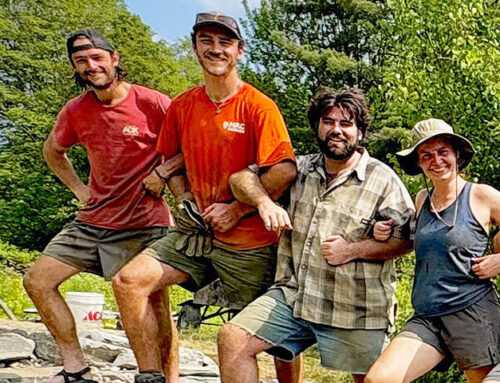
The work was led by the NFCT’s Allagash stewardship crew, with support from the Maine Conservation Corps, the Appalachian Mountain Club’s Maine chapter, community volunteers and the Allagash Wilderness Waterway.
“The Allagash provides some of the best outdoor recreation in Maine, and it’s vital that we maintain safe, accessible infrastructure for paddlers, anglers and other adventurers,” said NFCT Trail Director Noah Pollock. “The NFCT and its partners are committed to implementing projects that strike a balance between maintaining the wild character of the waterway while minimizing environmental impacts.”
“The allure of the Allagash is its wild and remote beauty,” said Nick Hall, the NFCT’s assistant trail director. “Camping in this area offers gorgeous scenery, but many of the sites themselves are in need of stewardship work. We learned from site visits that folks were starting to skip over certain locations because campsites were in varying states of disrepair, and because many of the trails were heavily eroded and muddy. Fortunately, we were able to make big improvements across the board and we hope outdoor enthusiasts will take advantage.”
“The water trail expertise and exceptional efforts of the NFCT crews and their partners have greatly improved the quality of our popular remote campsites,” said Mark Deroche, superintendent of the Allagash Wilderness Waterway. “Together, we are successfully enhancing wilderness character along our shorelines, mitigating serious erosion issues, and fashioning campsite features for all types of visitors. Our goal is to continue this important work until we have upgraded every campsite and access point so future generations are able to enjoy and marvel at the beauty of one of our nation’s premiere wilderness waterways.”
In 2025, the NFCT’s work crew and partners tackled projects along the Allagash Wilderness Waterway at the East Twin Brook campsite along the Allagash River, as well as a series of campsites on Chamberlain Lake. The work primarily focused on improving existing access paths and tenting pads to bring them up to accepted management standards.
The summer’s biggest project took place at Gravel Beach, where the stewardship crew focused on expanding accessibility for users with mobility issues and physical limitations. A new, ADA-compliant privy was installed, complete with a 20-foot inclined ramp to a lifted platform, hand rails and extra interior space. The NFCT collaborated with Enock Glidden of Outdoor Access Solutions on the project, who helped inform the construction process to make sure it met accessibility standards.
“The Allagash long seemed like an unreachable destination based on the local lore I grew up with in Patten,” Glidden said. “As someone who thrives on overcoming challenges, I saw this project as a vital opportunity to show the disability community that the waterway is a place for them to enjoy. Working with the Northern Forest Canoe Trail was an incredible experience that allowed me to finally access this remote wilderness. My hope is that the solutions we’ve implemented will open doors for countless others to experience the Allagash’s unique beauty.”
Crews also removed roots and rocks at Gravel Beach to make moving around the site easier, and the tent pads were refurbished.
At East Twin Brook, crews installed a new bench cut trail leading from the river access to the camping area. The old trail had eroded to the point where it was often muddy and unsafe, so users began creating their own herd paths, which makes erosion worse over time and harms the ecosystem; the new trail provides safe footing and better drainage. A new privy trail was also added. Formerly, users had to walk through other campsites to get to the privy; the new trail creates more privacy. Finally, new tent pads were created on level ground and with improved drainage.
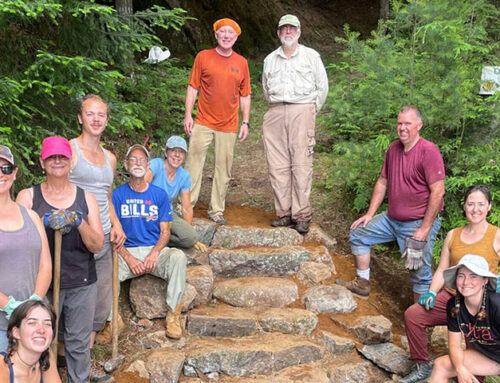
Other work completed included the construction of two sets of stone steps at the Boy Scout Campsite, with the goal of easing access to campsites from the lake. Both older stairways were constructed with timber and had rotted significantly. Additionally, the steps themselves were built too high, making them difficult to use when hauling gear or for those with mobility issues. Elsewhere, crews used mulch and topsoil to stabilize eroding banks at Boy Scout. Finally, crews again installed new tent pads and privy trails. These projects were carried out in collaboration with AMC Maine’s work crew in addition to NFCT volunteers.
“It’s always a pleasure to work with AMC Maine,” Hall said. “They’re great people and hard workers — we’re grateful for this partnership.”
Two more sets of stone steps were constructed at the High Bank campsite, making steep ascents from the water easier for paddlers. Workers also built new retaining walls at several locations, helping to stabilize banks and prevent erosion. Tent pads were also added to the High Bank campsite, and the crew made minor improvements to an existing privy trail.
“This was the toughest project of the summer,” Hall noted. “The steep steps made things difficult, and the more steps we installed, the higher up we had to move these heavy rocks. And removing the old timber steps meant getting rebar and tarp out. We were under a little pressure to get things done on time — it eventually worked out and we solved our problems, the final product was great, and the ranger we worked with was proud of the work. We have to work with what the environment gives us and be creative sometimes.”
At the Murphy’s Field campsite, the NFCT worked alongside the Maine Conservation Corps to install new tent pads. With permission from forest rangers, the crew got creative, using deadfall to create cribbed pads that visually fit the campsite’s aesthetic.
As the only dedicated water trail crew in the Northeast, the NFCT’s stewardship crew specializes in projects at the interface of land and water, including campsites, portage trails and access points. To learn more about the NFCT’s stewardship work, contact Trail Director Noah Pollock at noah@northernforestcanoetrail.